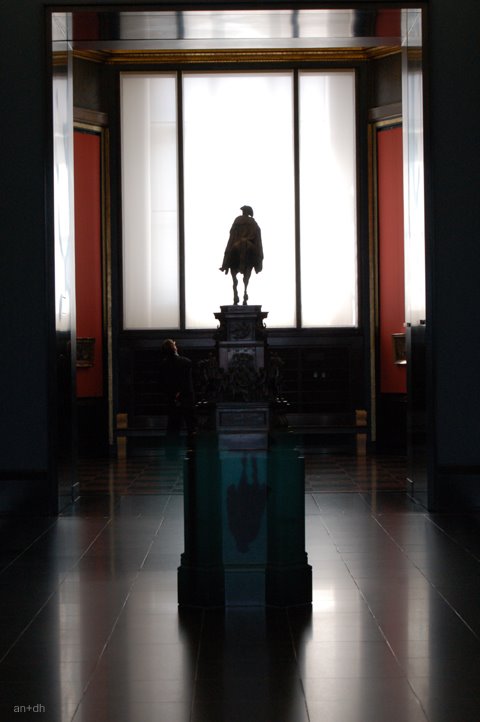
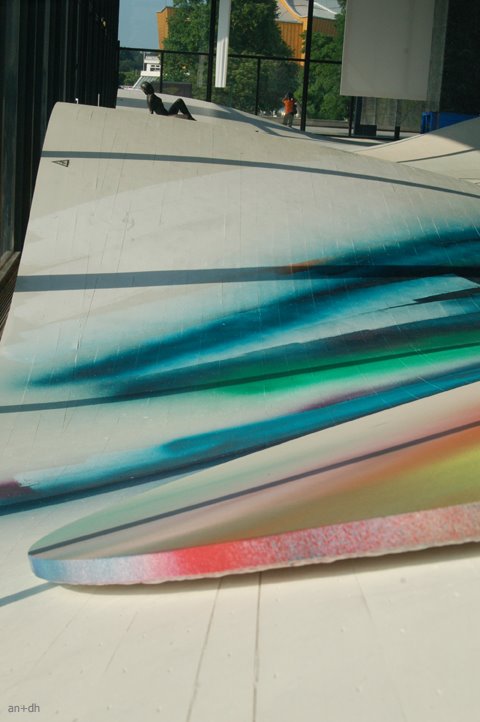
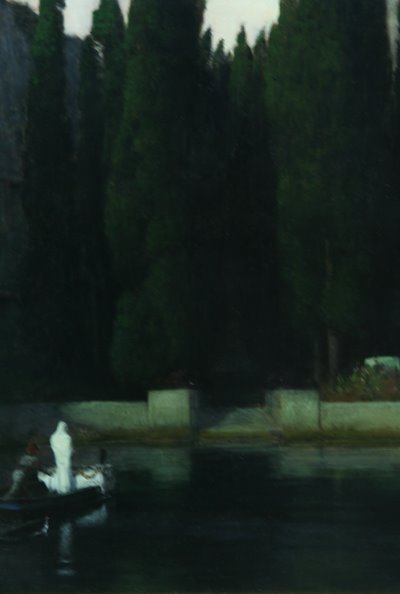
completed in 1876, this building housed a collection of fine arts, particularly of the German Romantic Period as well as some of the finest collection of 19th century sculptures.
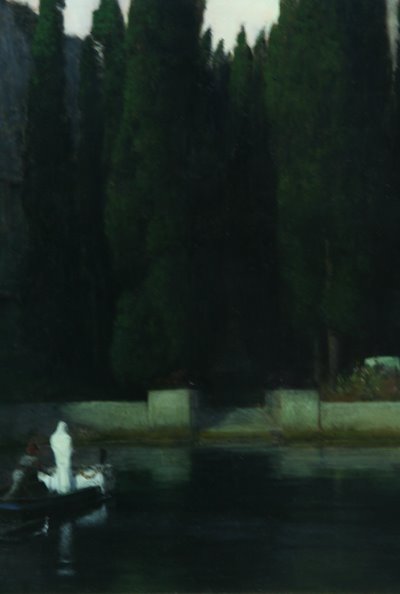
One important work is "The Island of the Dead" by Arnold Bocklin which was located on the upper floors. standing there staring at it, there's a mysterious force seemingly pulling one from reality to the picture world, all is silent, except the sound made by the boat gliding through the dark, placid water, signalling an ominous destiny. what lies ahead? there was not a clue except the distant cries from ravens deep in the woods...
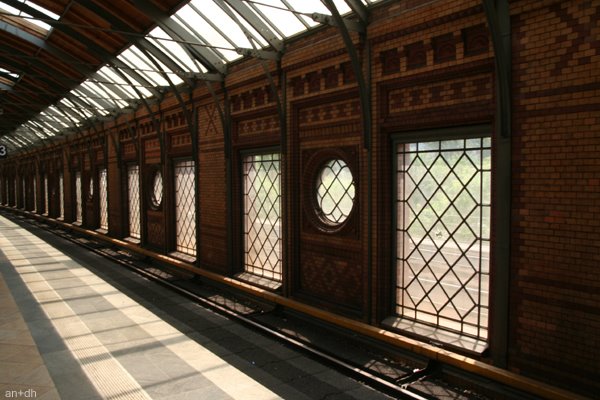
 other than works by masters of the contemporary era, Berlin has a number of old buildings dated back to the 1830s. the Museum Island is one such area which hosts such. Taking the S-bahn and getting off at the Hachescher Markt, it's only walking distance in reaching the Museuminsel. Records suggested that this island might well be the cradle of Berlin's history, and settlements began at 1244 at this very island.what could be better than housing some of the finest museum in Berlin?there are 5 musuems on this island, the Alte Nationalgalerie, the Altes Museum, Neues Museum, the Pergamonmuseum and the Bode Museum.
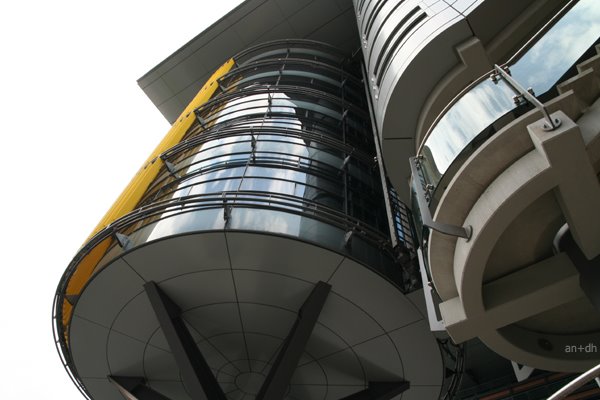
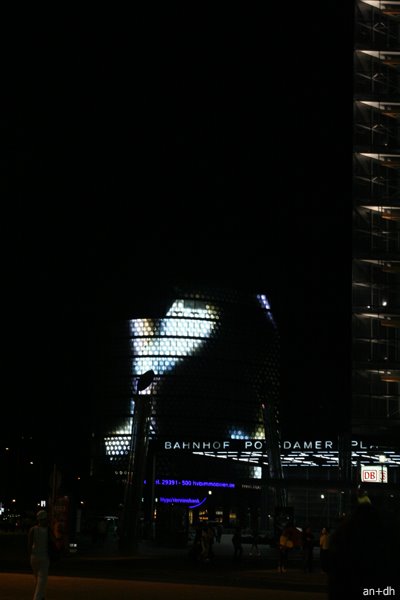
 pls correct me if i've got this one wrong. believed to be designed by Renzo Piano, this building is situated at the Postdamer Plaz. like the control tower of an intergalatic spaceship, just wondering the type of functions held inside this space?
a massive lawn adjacent (from the look of it, quite manmade) to this long building which can be nice place to take a nap during those long, lazy afternoon.
 designed by one of the most important master of modern architecture, Ludwig Mies van der Rohe, this nationalgalerie expressed the essence of "less is more". the generous headroom, an entirely transparent skin, together with the bold structure are all the elements that made up this piece of powerful architecture.he died in 1969, and this was his last work, a monument to modern architecture.
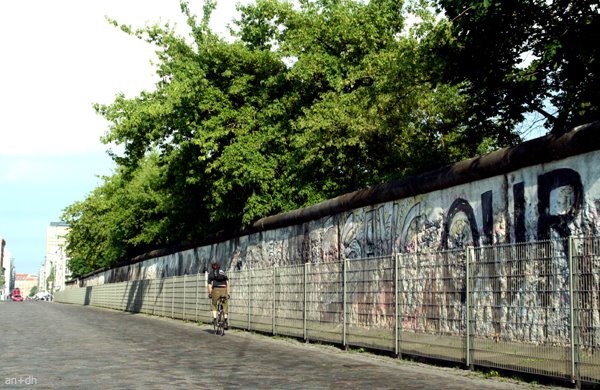
 the wall that once divided the east and west now becomes a statement of the past, marking an eventful era of the past.how many blood has shed?how many dreams were shattered?how many families were separated?all those are history now... and you can bring a piece of history home from the Checkpoint Charlie museum at EUR 7.00 for a piece of the wall...welcome to democracy.welcome to consumerism!
 if you were awarded to design for a museum, what would you do? check the possible future exhibits and design a space that would suit these items? a more universal space which can suit all kinds of exhibition? or disregard the exhibits, and design a space that can speak for itself even without the exhibits?
sometimes the decision is not for you to make, but a request from the client. architects are mere mortals, and we do have limitations.
when i was in the Jewish Museum, i had the strange feeling of mismatch between the vessel and the exhibits. with the Museum exerting a solemn, and heavy air, the exhibits were without emotion and sometimes even lighthearted...
nothing wrong with that, maybe it's just me...
how the space was designed and how the windows were positioned was quite amazing.
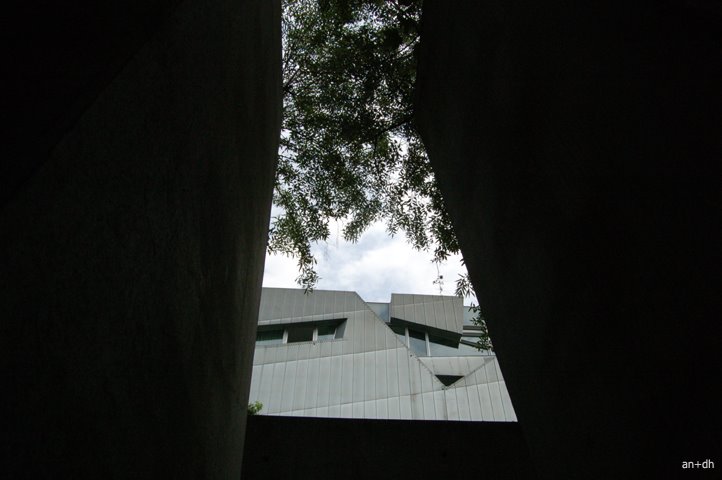
 an eyecatching piece of architecture by Daniel Libeskind. (the hyperlink takes you to his own website, which has a simple but interesting layout which is worth visiting also) "Between the lines" the theme used throughout in this project by the architect, to reflect the tensions of German-Jewish history.
from exterior to interior, there were numerous intrigue space to explore, how the planes met, where the lines were drawn, and how is a volume of space accentuated by depriving the space of light except at the apex of its height...
the museum alone is definitely not a piece to be missed if one is ever on the German soil. the exhibition gives a good account of the jewish history in the territory, however, there's some mismatch in the tone of the presentation of the exhibits and this piece of architecture.
 time to talk about the hotel we stayed during our visit in Berlin.
The Q! Hotel in Berlin, winner of numerous interior design award, took what's wall and what's floor to a new dimension.
for the furnitre, floor finish, wall finish, or even ceiling finish, they were all covered with the same material, marmoleum floor covering by Forbo, and gave a seamless continuity where one can no longer distinguished the difference between one face from another.
the price is for one night is high, not unexpected considering the hotel is frequently visited by fashion desingers, celebrities.
definitely worth a visit if u can spend a night there, and btw, the breakfast they served is excellent!
 in any major cities, one sight one can not escape is the use of state of the art LED lighting. its lifespan long, able to produce spectrum of colours, and can even orchestrated into a light show with proper programming. the problem is, while our cities become increasingly more colourful, our sense becomes more numb as we are losing our feelings towards some of these vibrant but meaningless pixels.
so when we saw this SPOTS installation at The Park Kolonnaden complex at Postdamer Platz, were instantly attracted to it. so it doesn't have colour, but its simplicity made the message stood out. the system apparently employed DALI (Digital Addressable Lighting Interface) system and able to capture images and redisplay them on the facade. interestingly enough, it is using none other than ordinary fluorescent tubes, the magic lies in the electronic control gear (ECG).
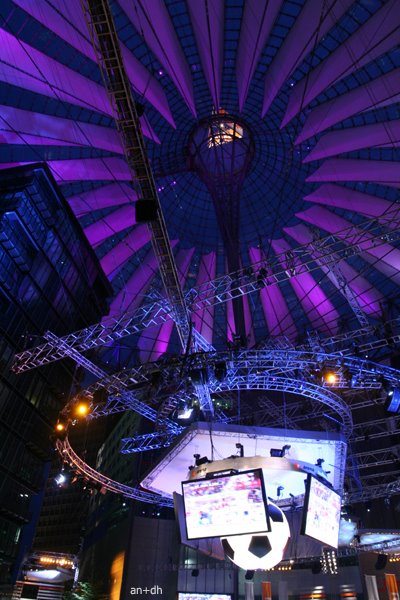
 during the worldcup period, if you couldn't book a ticket to enter the stadium and watch the match live, or that you didn't want to stay in the hotel to watch the tiny television, the best place to be, if you were in Berlin, was the Postdamer Platz.
you paid for an entry fee so that you could get a seat at the atrium where the huge television screen was. the price included food and drinks and were not overpriced, something we appreciated a lot. Germany was serious and focus in the events they organized, and they seldom use it as a marketing tool to extract money from visiting tourist.
the place was in fact a cluster of office buildings and entertainment venues, masterplanned by Hilmer, Sattler & Albrecht, the buildings themselves were the works of a number of different architects including names like Renzo Piano, Helmut Jahn, Richard Rogers, Arata Isozaki...etc.
the roof feature added the sense of volume in this space and was lit up with floodlights of various colours, a night marvel in itself.
 perhaps one of the most controversial race on earth, the Jewish population has endured some of the most frightening experience during the WW2.
one can read books, watch movies, or even visit historical sites related to the holocaust, but how close could one imagine or even attempting to understand the fear, hopelessness, despair that the Jewish people experienced?
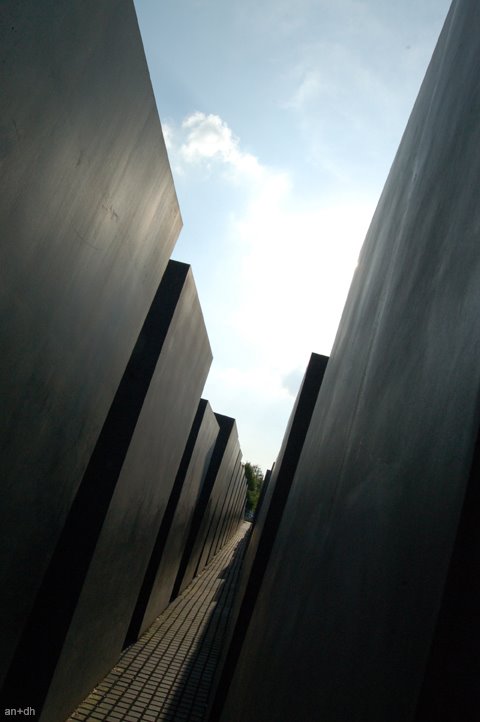
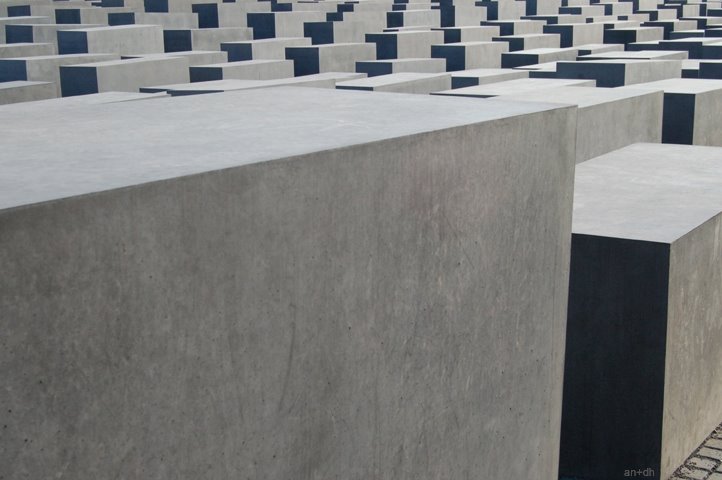
went into the Memorial to the Murdered Jews around 3pm on a sunny weekday, at the height of the WorldCup fever, yet, once you entered the orthogonal laybirith, with the floor undulating in unexpected ways, and the concrete columns suddenly towering over you at the heart of the installation, the chill that sent thru your spine, so many people around you yet you can not see them, hearing voices muttering but not knowing their whereabout, one was suddenly catpulted back to a dimension where there was no hope, and the future was bleak...
other than a piece of work by Tadao Ando in Himeji i visited years ago that gave me such a strong impact, this installation has hit home a sensation that can not be described in words...i was speechless, and felt that i was among the Jews, waiting to be escorted to the path of utter darkness...
this is the power of architecture.
 maybe due to the kind of media exposed to, or never have been to one of the built works, or indifference to his architectural philosophy in relation to the complexity theory, never particularly liked Peter Eisenman's works.
after visiting the memorial of murdered jews in Berlin, however, have somehow changed my attitude towards his work.
there's a certain delicate treatment to the seemingly unimaginative rows of upright concrete slab. from a distance, it was overwheming due to its sheer size, and monumental solemness. but it's only when you enter this concrete maze, then you realize it's more than what one could anticipate...
 there was a whole lot of architecture to be seen close to the Brandengurger Tor, and any attempt to see all in one day would simply spoil the marvels. it was a hot day, and we were dying for a drink, walked past this building, not knowing what it was, but could see a bookshop, a bar and some funny looking installation through the curtain wall on the front. unlike some of the buildings nearby (as it was already 5 in the afternoon), the doors were unlocked, we entered, and found out this was actually the akademie der kunste. not that we didn't know it exist before hand, but our main objective after visting the Brandengurger Tor was actually the Memorial to the Murdererd Jews. so discovering the akademie was a pleasant surprise.
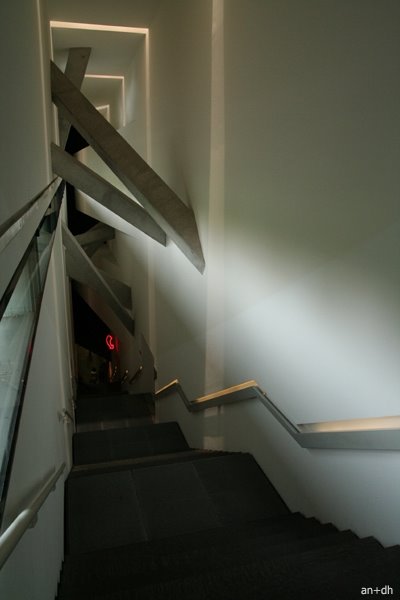
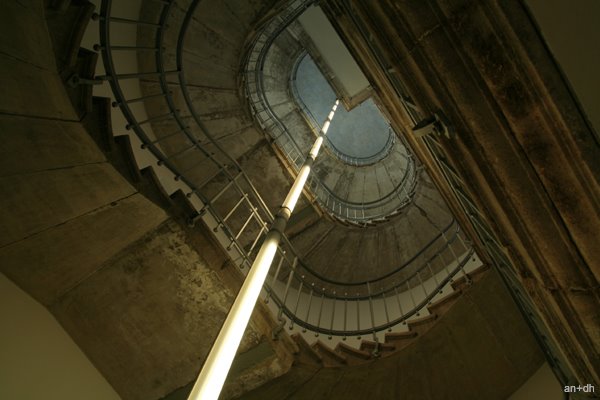
there was an exhibition going on with large scale installations, some rather interesting works. but it was this staircase which caught my attention most...
of this building, everything seems to be very architectural of the contemporary era, steel staircase, angled glass, white walls, self-leveled flooring, slanted furniture...and suddenly, saw a staircase which was totally unsimilar to any of its surroundings, something from another moment in history...made me wonder was this all that remains from its previous incarnation, or was it a replica of somewhere inserted into this space?
took the steps, heard sound from above, anticipating an encounter of of an unusal kind...
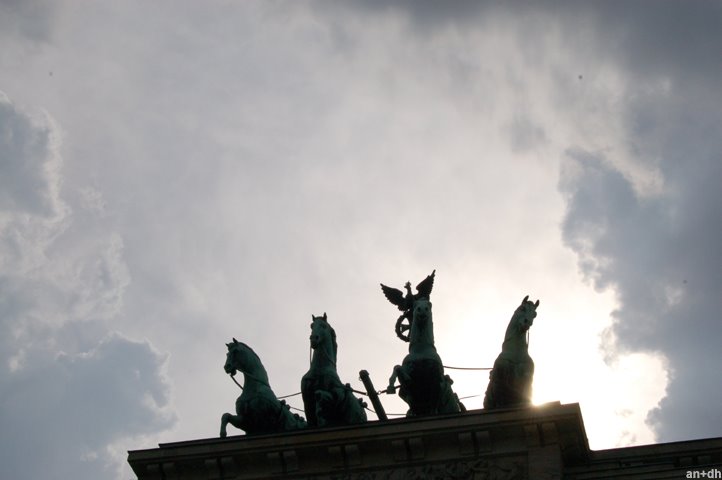
 what once stood in East Germany and overlooking the many events happened before the removal of the Berlin Wall, this Neo-classical structure, modelled after the Athenian Propylaea, with Victoria, the goddess of victory, driving the Quadriga.
located at the end of Unter den Linden.
there was a very useful tourist information centre just by the side of the gate which has ample information on architecture, but watch out for the date when it is closed!
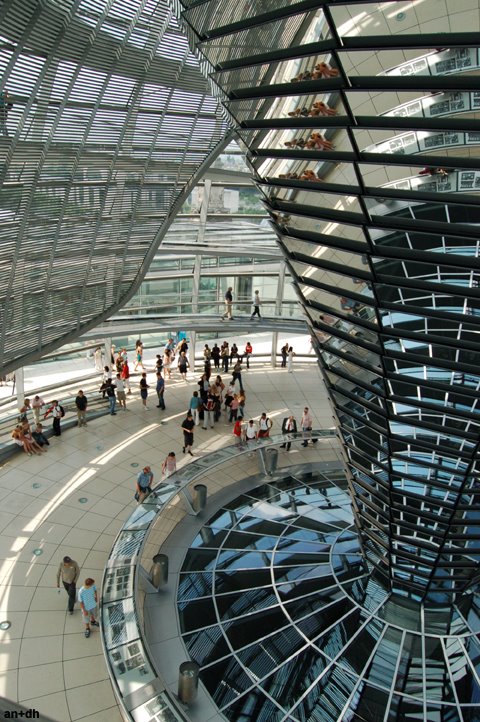
 the massive mirror fixture, apart from giving some very nice reflections through its tilted angle fixings and becoming the central focus of the enclosure, serves another purpose of bringing in the natural day light through to the assembly hall below.
the glazed roof of the hall, which is transparent for the public to look into, perhaps symbolize the transparency of the government...but while you can see inside, you can't really hear what's going on inside, a bit ironic...
while expecting the details to be hinged of joints, and allow the fixings to a certain degree of movement, was surprised to see most are welded joints...
 designed by Foster and Partners of United Kingdom, this piece of architecture easily top the list of must visit site in Berlin. it's free of charge to get in, but due to all the security check, expect to queue outside for a bit before you are eventually admitted into the premises.
once inside, the elevator will take you to the roof of where the iconic copola is. there is plenty of information regarding the background of this project listed in the architect's homepage.
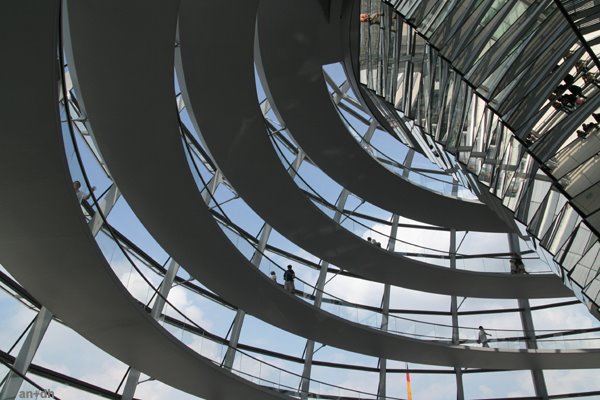
the day when we visited was at the height of summer, and this glass structure was in fact not air-conditioned but relying on stack effect and natural ventilation through the openings on the screen. was it effective? of course not as comfortable as a fully air-conditioned building, but comparing to the heat on the street, this was not so bad.
2 parallel running ramps encircle the inside skin of this architecture and can take you all the way to the top, which is opened to the sky, uncovered! quite a surprise.
this place deserves another entry to talk about.
 while the taxi in Berlin is of reasonable rate, and the S-bahn and U-bahn are both efficiently run, it is expected of the general public that plenty of travelling are to be done on foot, and it often has signs saying 400m to Point A, 300m to Point B...etc. which is good for urban dwellers who are so lack of moderate exercise anyway.
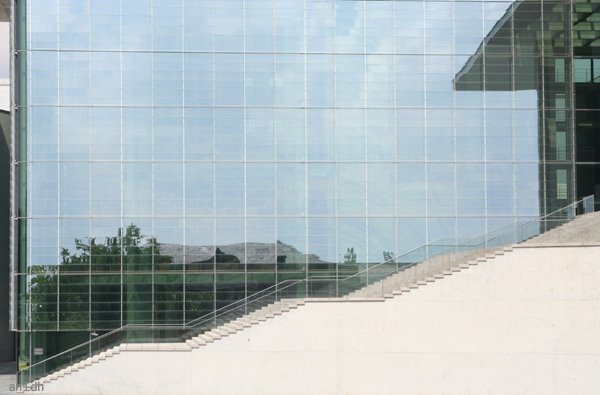
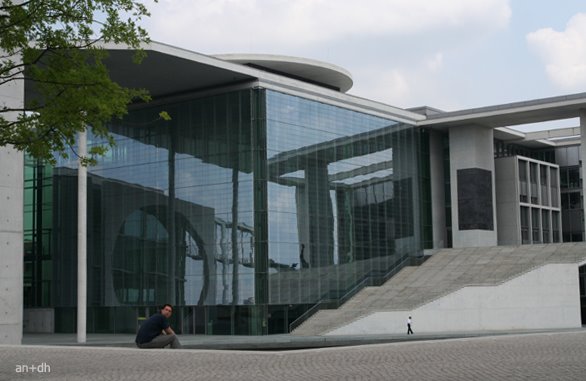
on the way to the Reichstag, there's a route which took one along side the river Spree. Clean, institutional architecture set the backdrop for the walk.
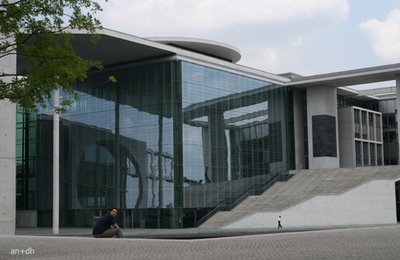
we had some difficulty in identifying this project as not many books or literature covered it. apparently it housed the library and reference section for the Chancellery nearby.
architect for the project is Stephan Braunfels.
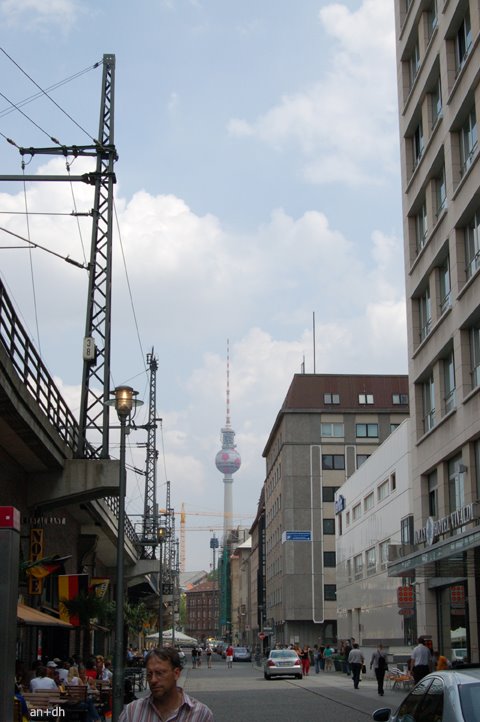
 one of the landmark in Berlin, the Fernsehturm in the Mitte area.
my first thought was that any spy movies must have a go at this TV Tower especially in the 70s, as it does give a certain aura of that time. The mainbody has the look of a football, most probably 3M stickers being put on for the 2006 WorldCup.
incidentally, the TV tower was built between 1965 to 1969 by the GDR (German Democratic Republic), or better known as, East Germany.
and that certainly gives you another motive to visit it.
this picture was taken when we just got off the S-Bahn Friedrichstr station on our way to Reichstag.
 the journey lasted for about an hour.
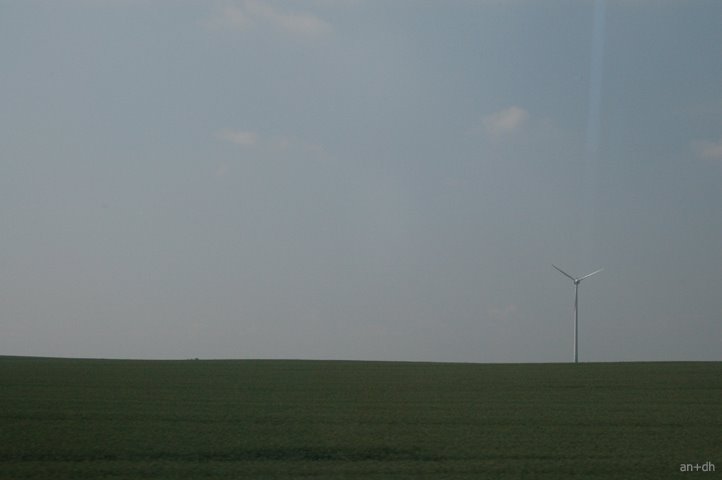
once out of the station, either side of the train opened up to a vast field of greens. occasionally came in to view were the wind turbines.
as common to the very essence of daily life, Germany is meticulously conscious on the energy efficiency and green issues: escalators come into life only when a person approaches; lights dimmed down or switched off when no one is in the corridor, actuated most probably by motion sensor and dimmable energy efficient T-5 fluorescent tubes; parking meters are operating on solar energy. the people as well as the country are well aware of energy saving issues and utilizing alternative energy other than fossil fuels.
in contrast, while claiming as World City, Hong Kong is quite backward in energy concerned issues, just how many buildings were designed to tackle the punishing heat of the summer sun other than using an even more powerful air conditioner to cool down the air? the excessive light shows, which are burning the valuable fuels everynight, to signal that the city is prosperous, advanced, that we bring light to darkness, water to the desert, what cost there is to the environment?
China is catching up in an extremely fast pace in terms of car ownership, and is in the process in striking a new deal with the Venezuelan government on the supply of petroleum...
are we heading the right directions?
 the weather changes according to different seasons, mirco climates, radiation of the Sun, reaction forces between planets, or as far fetched to the vibration of a pair of butterfly wings.
can it be accurately predicted, presumably yes in theory, if you have a way to store in all the data that is happening in the universe, from Time-Zero to the moment you want to know the result. But if we accept that the universe is infinitely large, then things happened at all corners (or will there actually be corners?) of the universe needs to be recorded on a machine that has infinite capacity...
"tempermental as weather", that's how we describe the mood of a person which is unpredictable.
the question is, is a person's mood really unpredictable?
many years ago, saw a documentary by QED of England, citing a person was charged with murder, but defense claimed that the man on trial was subjected to a chemical spillage, and the chemicals he inhaled affected his brain, therefore, his decisions and subsequent actions. guilty or not was a legal issue, but suppose we understand the effect of such chemicals and how it will affect a person's mind, can we then, theoretically, predict the mood of a person if we understand all circumstances, actions affecting that person before he/ she swings into a certain mood?
why am i writing this?
affected by the picture in front of me.
why was there someone still working at the height of the WorldCup fever?
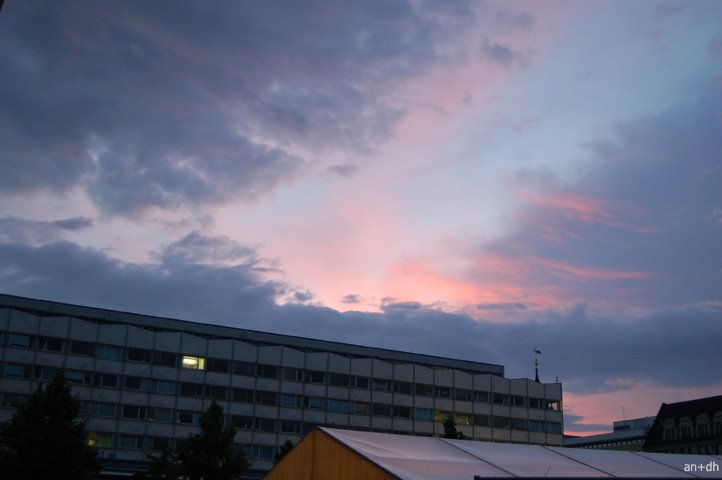
thousands of possibilities were already crawling towards the window...one of final pictures we took the night before we leave Leipzig the next day.